
Hemp biomass can ship across state lines when it meets the federal definition of hemp. From December 11, 2026, that means it tests at 0.3% or less total THC (delta-9 THC plus THCA) on a dry-weight basis. Biomass over that limit is a controlled substance under federal law, whatever the states on the route allow. Send the lab report, the grower's license and a bill of lading with every load, and pick the truck by weight.
Updated November 20, 2026. This page replaces our separate state-by-state biomass pages, which said the same thing for every state. This is general information, not legal advice. Confirm current rules with USDA and the states on your route before you ship.
What counts as legal hemp biomass
Congress narrowed the federal definition of hemp in Section 781 of Public Law 119-37. Most of the change takes effect on December 11, 2026, under Section 2019 of Public Law 119-103. For biomass, three things matter:
- The limit counts THCA. A lot that passed at 0.3% delta-9 THC can fail at 0.3% total THC. Check the lab report before you book.
- The test is on dry weight. The certificate of analysis (COA) should report total THC on a dry-weight basis for the lot you're shipping.
- The grower must be licensed under a USDA, state or tribal hemp plan. That's what makes the load "lawfully produced" hemp.
Our guide, Is it legal to ship hemp across state lines?, covers the full rule change and every other hemp product.
Paperwork to send with a biomass load
Federal rules don't list required shipping documents for hemp. USDA's hemp rule "strongly encourages" sending four things with each load (86 FR 5596, January 19, 2021):
- The COA for each lot on the truck, showing total THC
- The hemp grower's license
- The bill of lading or invoice. List the weight, the lot numbers and the commodity, so each sack matches a COA.
- Contact details for the buyer and the seller
We ask for these before we book a biomass load, and the driver carries copies.
Which truck fits your load
Biomass usually ships in super sacks (bulk bags), loaded on pallets. Weight decides the truck. These are the ranges we plan with. A light, fluffy biomass fills a trailer before it reaches the weight limit, so tell us the number of sacks and their size as well as the weight.
| Load weight | Truck we'd quote | Space |
|---|---|---|
| Under 1,000 lb | Usually cheaper by parcel or LTL carrier | Check the carrier's hemp policy |
| 1,000–2,000 lb | Sprinter van | About 12 ft long, 4 ft wide |
| 2,000–6,000 lb | Box truck | 12–26 ft long, about 8 ft wide |
| 6,000 lb and up | 53 ft dry van or reefer | 26 pallet spots |
A 53 ft trailer holds 26 pallet spots. At 500 lb per sack, one layer of sacks is about 13,000 lb. Stacking sacks two high, when they're stable, brings that to about 26,000 lb.
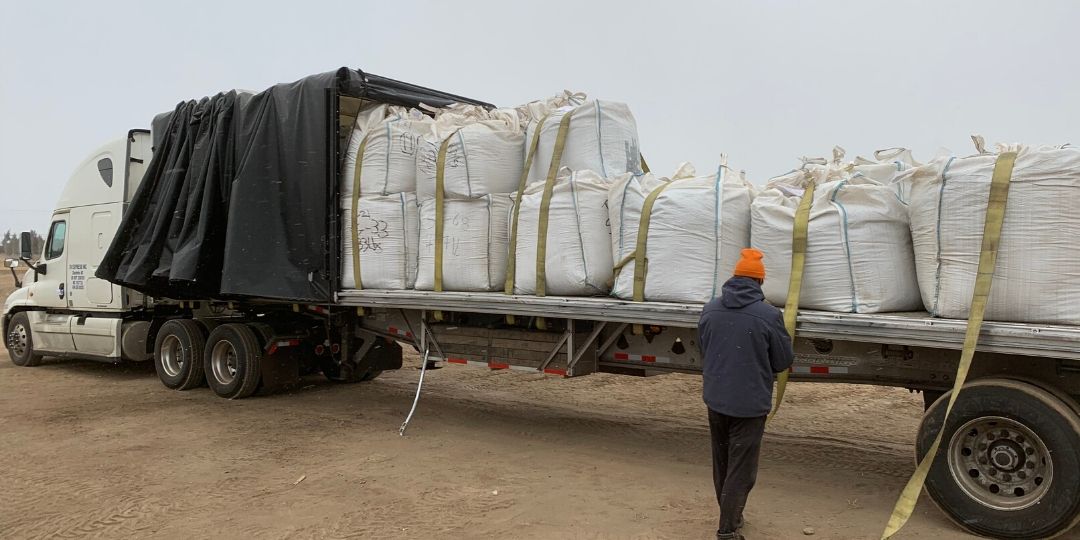
Biomass can also move on a flatbed with a tarp or a rolling-tarp trailer, as in the load above. Tell us if your site loads from the side.
Do the rules change by state?
The federal definition is the same in every state. States can't ban lawfully produced hemp from passing through: Section 10114 of the 2018 Farm Bill says so (7 U.S.C. 1639o, statutory note), and USDA repeats it in 7 CFR 990.63.
States do still matter in two ways:
- Licensing. Each grower is licensed under a USDA, state or tribal plan. The USDA hemp program lists who runs the plan in each state.
- Processing and sales. The delivery state can regulate what the buyer does with the biomass. Check its rules before you ship.
Insurance for biomass loads
Not every carrier's cargo policy covers hemp. Ask for the certificate of insurance and confirm with the carrier's agent that hemp is covered. For high-value loads, ask us about extra cargo coverage. Our cargo insurance calculator gives a quick estimate.
Get a biomass quote
Request a quote with your pickup and delivery locations, the weight, the number of sacks, and the COA. You can also call (313) 651-7060. For the rest of our hemp guides, see the hemp resource center.
Sources
- Public Law 119-37, Division B, Section 781: the new federal definition of hemp (signed November 12, 2025)
- Public Law 119-103, Section 2019: the delay to December 11, 2026 (approved September 2, 2026)
- USDA, hemp production final rule, 86 FR 5596 (January 19, 2021), and the USDA hemp program
- 7 CFR part 990, including Section 990.63 on interstate transport
- 7 U.S.C. 1639o: the hemp definition and the 2018 Farm Bill transport protection